Blake, Neo-Platonism and the Material Imagination

Early on, as a high school student, I became interested in Neo-Platonism. It seemed to connect many of the intuitive thoughts that I was having and give them form and relationship. Later in college, I formally studied Neo-Platonism as a philosophy major and I still felt it touched on many of my intuitive ideas. I recently read a book on William Blake and his relationship to Neo-Platonism titled, Blake and Antiquity by Kathleen Raine (part of the Bollingen Series, 1962). This might in fact be the very reason I am so attracted to the evocative drawings and dream like images of Blake.

Raine begins her essay,

“Neo-Platonism may be compared to an underground river that flows through European history, sending up, from time to time, springs and fountains; and wherever its fertalizing stream emerges, there imaginative thought revives, and we have a period of great art and poetry.” (Raine,p.4)

The English Platonist, Thomas Taylor had a powerful influence on Blake who, simultaneously, was reading the works of Swedenborg. Taylor called upon the,

“Young men of the new age…to enlist under the banner of Plotinus, confident that…the weapons of truth, in the hands of vigorous union, descend with irresistible force, and are fatal wherever they fall.” (Raine,p.5)

Blake begins his own personal journey discovering his Platonic leanings in the work entitled, Cave of the Nymphs. The symbolism that he longed for, that was both old and new, became evident in Neo-Platonism. It encapsulated his love of the ancients and brought them into the modern age through a symbolism that transcended time. Raine states, “… the language may at times be forgotten, yet we cannot call it dead; for the visions it describes are, as Blake says, ‘Permanent in The Imagination’; the beauty and the meaning of such symbols is unaging.” (Ibid.,p.8)

One of the Platonic ideas that Blake spent much time meditating on is the idea that souls descend into generation. Heraclitus states,”…birth into the cave is a death from eternity, the sleep of forgetfulness that overcomes those who, as in Plato’s parable, drink the waters of Lethe and are born on earth.” This concept is evident in Blake’s painting, The Sea of Time and Space (1821). In this painting, there are figures with looms and shuttles, weaving the garments, the body, that the figures will wear when they enter life. In this painting,souls take on the materiality of existence and are born into the world.

But one thing I sense in Blake is that he does not just stop at identifying with Platonic ideas. He goes one step further. He identifies, as the artist, with this material embodiment. What is the artist, but one who takes an imaginative leap by carrying his idea from thought and manifesting it into a material form. Artistic creation is the very act of materializing a thought, feeling or intuitive insight, into a vessel that reveals those thoughts and feelings. The artist needs matter to create. The artist, not only transform matter, but also invests his own soul into that creation.This, too, is a materialization of a spiritual movement that takes place within the artist. Any artistic undertaking is a conjunction between thoughts, soul and matter.

Related but conversely stated, Gaston Bachelard believed that,” We need to first imagine something before we can discover it.” Matter must first be imagined before the senses can percieve it. Matter only takes on ‘life and existence’ after the entrance of the imagination. Blake elaborates in The Songs of Innocence, that it is the imagination, not the senses, that are able,

“To see a world in a Grain of Sand

And Heaven in a Wild Flower,

Hold infinity in the palm of your hand

And Eternity in an hour.” (Ibid.,p. 88)

Blake writes, “Every Natural Effect has a Spiritual Cause.” Blake believes in the artists’ ability to be a catylst of movement between the spiritual realm(imagination) and the world of matter. The artist acts as a medium between worlds. “When man lives imaginatively, his world is determined by quality” and unity. The artist is a projection of the oneness that is possible in living the creative life. Blake states,

“Heaven above, heaven beneath,

Stars above, stars beneath,

All that is above is beneath.

Understand this and be happy.” (Ibid.,p.79)

Material imagination, the imaginative quality of soul, of ‘vision’ as Blake puts it,”… regenerates and resurrects Nature… and Paradise is regained.” (Ibid.,p.100) Blake continues this thought which reaches it’s apex, “I see Every thing I paint in This World…to the Eyes of the Man of Imagination, Nature is Imagination itself. As a man is, So he Sees.” (Ibid.,p.100)
Dynamic Symmetry and William Blake

This summer I read some interesting books I had acquired on Cape Cod in May. They ranged from compositional methods to philosophical writings to the alchemical relationship between paint and artist to color theory. When one reads several books simultaneously one finds oneself making analogical connections between what appears to be separate studies. These analogical insights usually come unprovoked. Somehow the unconscious is linking things in their proper substantive relationship that one would not necessarily see at first sight. Baudelaire called this acknowledgement of intuitive relationships a “correspondence”. I found such a surprising analogy or correspondence between the writing of William Blake and the compositional theory of Jay Hambidge in his book on The Elements of Dynamic Symmetry, 1919. These are the two ideas I found fascinating and strangely connected: Hambidge’s idea of the reciprocal of a rectangle and William Blake’s insight,”… nature (Blake called), is one continued (continuous) vision of imagination.” (Kathleen Raine, Blake and Antiquity, Bollingen Series,1962, p.3) Obviously, patience is needed for me to explain this analogy. So let me begin with what is a reciprocal of a rectangle.

A lesson in “The Reciprocal”:

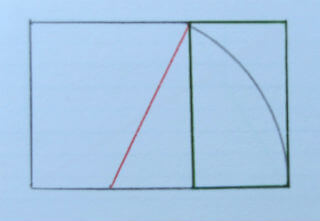
Jay Hambidge believed that , “A process connected with the science of plan-making which was thoroughly understood by the Greeks, was that of determining the reciprocal of a rectangle. A reciprocal of a rectangle is a figure similar in shape to the rectangle but smaller in size.” (Hambidge, p.30) The ratio of the larger rectangle is the same as the smaller one (contained within the larger rectangle) with only a variance in proportion. To create a dynamic rectangle, one begins with a square,which Hambidge refers to as a unity or 1. This term is important for what I will express later. And from this unity, one adds a reciprocal, which is an addition of space that creates a rectangle that fufills a Golden Section proportion.

Example 1

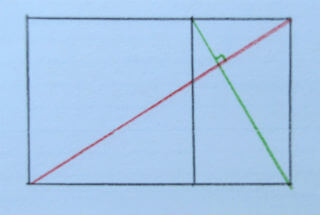
So from a square or a unity one creates a rectangle that contains the unity plus a rectangle that is the same ratio as the whole or larger rectangle. Building a golden section rectangle depends, “… upon the fact that the diagonal of the reciprocal cuts the diagonal of the major shape at right angles.” (Ibid. p. 30).

Example 2

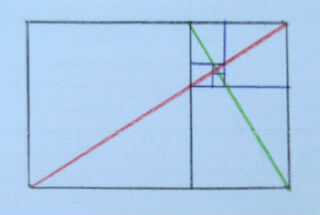
And within this rectangle, referred to by Hambidge, as the ‘whirling square’, one can create an infinite number of reciprocals that spirial around a fixed point, creating again and again an infinite number of rectangles that are of the same proportional relationship. Every rectangle within the larger rectangle is related and analogous.

Example 3

So from a unity, one creates another deep unity that is no longer a square but a rectangle that contains the unity and has within itself a rectangle that reflects its larger whole. This is the key to what I found interesting and analogous to Blake.

William Blake:

Blake states that, “… nature is one continuous vision of imagination.” Blake states elsewhere that, “every Natural effect has a spiritual cause.” Nature, itself, is analogous to the imagination. Nature is a continously unfolding, visionary product. Nature, itself, is Imagination.

But how is this product generated and by whom? Blake was heavily influenced by the Neo-platonists as well as his own Christian faith. The source, Blake seems to imply, is Divine. Divine, in the Christian sense, as well as in terms of Platonic thought, “All things exist in their ‘Eternal Forms’ in the Divine mind.” There exists an ‘Imagination’ that is beyond human comprehension, in a way. I say, in a way, because if I take the idea of the reciprocal– that the rectangle created beyond or in addition to the unity (square or 1) is proportional to the larger rectangle (the whole)- I see that they are analogous and the only real difference is size. The human element is contained within the larger Divine Element, and yet directly mirrors the larger whole in such a way that the only difference is one of proportion. The human capacity to imagine is analogous to the capacity of the Divine to Imagine. To Blake, the imagination is the very essence and material substance of Nature. It is the imagination, that is able

To see a World in a Grain of Sand

And a Heaven in a Wild Flower,

Hold Infinity in the palm of your hand

And Eternity in an hour.

(Songs of Innocence)

Gaston Bachelard states in Earth and Reveries of Repose that , “The imagination is primary and precedes any action or observation. (Precedes is the key word.)  Imagination then takes experience (One’s conscious life in the world) and enlarges upon it, searing it into our souls.” And again, “Imagination immediately turns a substance (matter) into a value (quality) and therefore material images transcend sensations.” Kathleen Raine states in Blake and Antiquity that,”Blake considered the Divine Imagination to be present in all men- indeed all creatures.” (Raine,p.88) The outward forms of nature correspond to the informing mind or life.(Ibid.90) One could take the idea of the reciprocal further and say that the rectangle of the ‘whirling square’, in which one can infinitely create a reciprocal, reflects that the Divine Imagination can be carried into every creature that lives, and the only variance is proportion.- beginning with the Divine Imagination to the human imagination to the imagination of an animal to that of an insect etc. -through all things that have life in existence.This allows Blake to pronounce that the, “Imagination is not a state; it is Human Existence itself.”

“That which is above is like that which is beneath, and that which is beneath is like that which is above, to work the miracles of one thing.” (The Marriage of Heaven and Hell)

Raine continues this thought, “the hidden thoughts of man are his share in the Divine Imagination- hidden, perhaps, as Jung has described the archetypes that determine our nature,  because inaccessible to normal consciousness; they create us, not we them.” (Ibid.90) Blake calls us to recognize phenomena as a portion of the ‘soul’ regenerating and ressurrecting nature. Imagination re-invests the world with meaning and beauty and subsequently creates a world in which art connects us, not only to nature, but to that interior soul that yearns to know itself- through the beautiful. Blake refers to the artist as one open to that ‘portion of soul’. ” I see Every thing I paint In This World,” Blake wrote, “… to the Eyes of the Man of Imagination, Nature is Imagination itself. As a man is, So he Sees.” (Ibid.,p.100)

As a man is, So he Sees.