The Winter Landscape and The Pervading Neutral

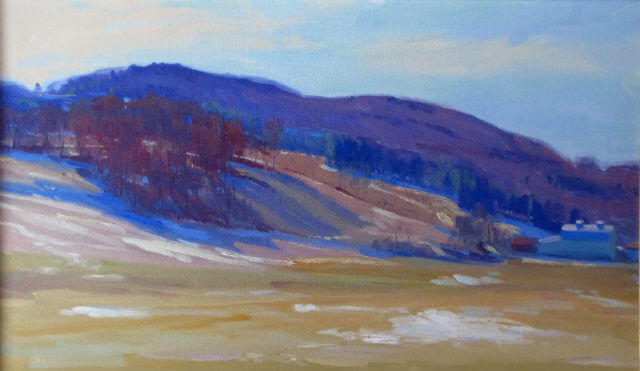
This week in the Catskill Mountains, it has snowed everyday. Beautiful clean, white snow. What I love about the winter is this wonderful neutral that pervades the landscape. All those subtle tones of gray, blue- gray, violet and russet reds, appear so much more intriguing. Set against this neutral of white, those more subtle tones take on an added vibrancy. With the surrounding neutral, one can see the grays more clearly and instead of mixing a color that is completely neutralized, one can break down that neutral into several tones.

There are russet grasses along the fields and riverbanks near where I live. I love this subtle red because red in the landscape is very rare unless one is talking about a man made structure. Sometimes these grasses appear as a strong accent and at other times they vary from a strong red to a more subtle orange or an ocher color. I find that a combination of viridian  and orange gives this gold tone. And into this I can add a more distinctive red tone without it taking over because the viridian acts as a neutralizer to this red and thus creates a russet color to the grasses without it becoming too pronounced. I prefer working with these three colors rather than strictly a red/green complement. Adding this type of variety to the grasses allows one to place the grass in the composition through color temperature- warmer tones approaching the foreground and cooler tones as it recedes into the background.

The far hills, during this time of year, appear as subtle gray-blue tones to blue-violets tones. In the middle of winter when the skies are overcast, there is a close relationship in color temperature between the sky and far hills. The looming clouds hang over the hills reflecting their violet tones into the hills and the color from the hills themselves also being reflected back into the sky. This violet tone tends to pervade everything including the snow. So it is important to add any kind of variance to these violet tones that one can find. If it is all too neutral, it becomes uninteresting and there appears to be no light emanating from the canvas.

I divide the tones I see in an overcast winter landscape into blue; blue-violet; and violet- red. Accentuating the blues at first in the initial block-in and then later over-laying in the pervading violet to violet-gray. And I tend to off-set all this violet with a subtle introduction of orange or orange-yellow. Since the sun is low in the sky in the winter, this warm color can be seen in the lower sky and subsequently, reflected in some of the snow. This adds a more compelling element visually, the warms and cools playing off of each other.

One cannot describe all that goes into every landscape, but I have indicated some of the things I find so interesting about this time of year. The blanket of the neutral white ties all of these beautiful tones together gathering them in and showing them off in a unique way. It was always George Bellows favorite time of year. He even titled one of his winterscapes of skaters in Central Park as,”Love of Winter”. If one has the endurance, in many ways it is the best time to paint out-of-doors.
Envisioning the Image

One of the most difficult things about beginning a painting is being able to envision what it will look like when it is complete. This envisioning the painting beforehand is critical and is often overlooked. But how can one even begin if one does not know the path one is to take? Monet said (I believe it was Monet), “don’t paint anything if you cannot imagine it first as a painting”. One needs to see in the mind’s eye the image in as much detail as possible- what it will look like; how the color will flow; what will be the focal point and how the painting process will reveal this; how the melody of color and form will heighten the emotional content; how the composition will bring this all together to create a lasting impression. One will only know if a piece is complete if it fulfills this first “vision.” Otherwise, one is apt to paint on it continuously because as moods change, both for the model as well as the artist, the sense of the painting changes. Before you know it you are lost in “the dark wood”.

There is also the question of technique. The proper technical means to achieve the desired result will be found because the image itself will call forth what it needs in order to speak . This puts technique at the service of the image and not the other way around. Technique must succumb to this envisioning process. Henri states,

“It is useless to study technique in advance of having a motive. Instead of establishing a vast stock of technical tricks, it would be far wiser to develop creative power by constant search for means particular to a motive already in mind, by studying and developing just that technique which you feel the immediate need of, and which alone will serve you for the idea or emotion which has moved you to expression. You will not only develop your power to see the means, but you will acquire power to organize the means to a purpose.” ( Robert Henri, The Art Spirit, p.220)

Possibly a new approach will be necessary in order for the image to be realized. Finish will come when the means has approached the initial “vision.” To seek technique for its own sake is a vapid exercise.

This does not mean that spontaneity is removed from the process. One always needs to be attuned to the moment for it is in the moment that we get a glimpse of what lies hidden beneath the surface. But if one provides the framework of meaning and emotion, spontaneity has the chance to dance upon that structure adding greater depth to a piece. And this is what you want- a combination of opposing forces, true to our experience of the natural world.

Locating one’s vision is sometimes,unfortunately, referred to as “what do you want to say?” but language is limited and image usually goes beyond the verbal to contain something more deep and unspoken. Words cannot contain the thought or the feeling in quite the same way. When one has a feeling for an image, a vague sense seeking form, by what means can the artist come to know that image more fully? In what way can he allow that image, that remains somewhat hidden, to reveal its self?

As a practice, I attempt to draw the image from my mind’s eye first. Repeating this process until the image speaks back to me that feeling I am after. Then I recreate this image using a model and whatever other means necessary, again repeatedly doing studies until the image “speaks” back to me. Then I tackle it from the angle of color and melody by painting color studies from memory until they contain the right emotion. Finally, I paint a color study of the model combining my feeling for color with the reality before me. It is this final combination that brings me close to envisioning what my piece will look like when it is complete. The french academies of the 19th century referred to these final studies as etudes. It is a vision or summation of the final painting, containing all the elements and emotional content that the final piece will entail. It is the “spirit” of the image seeking its final fulfillment. In many ways these etudes of the 19th century have a greater impact to our modern sensibilities than the later Salon pieces because the forza is immediate and finish is reduced to a minimum. In the end, it is the furia and intentionality that we seek to translate in a visual form- making it tactile and leaving an impression that will reside in the memory. [Furia– the living quality, the height of invention. (David Summers, Michelangelo and the Language of Art,p.63)]